

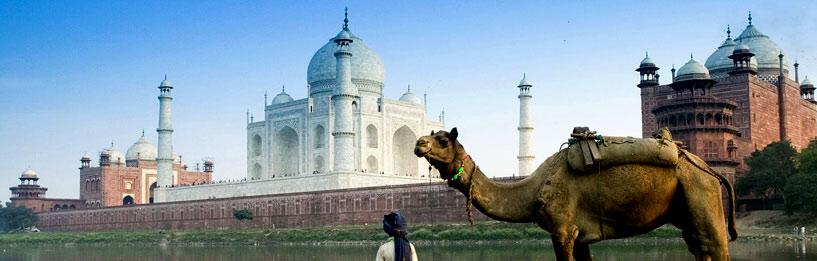
About Taj Mahal

Taj Mahal, Agra
Taj Mahal was built by a Muslim, Emperor Shah Jahan (died 1666 C.E.) in the memory of his dear wife and queen Mumtaz Mahal at Agra, India. It is an "elegy in marble" or some say an expression of a "dream." Taj Mahal (meaning Crown Palace) is a Mausoleum that houses the grave of queen Mumtaz Mahal at the lower chamber. The grave of Shah Jahan was added to it later. The queen's real name was Arjumand Banu. In the tradition of the Mughals, important ladies of the royal family were given another name at their marriage or at some other significant event in their lives, and that new name was commonly used by the public. Shah Jahan's real name was Shahab-ud-din, and he was known as Prince Khurram before ascending to the throne in 1628.
Taj Mahal was constructed over a period of twenty-two years, employing twenty thousand workers. It was completed in 1648 C.E. at a cost of 32 Million Rupees. The construction documents show that its master architect was Ustad 'Isa, the renowned Islamic architect of his time. The documents contain names of those employed and the inventory of construction materials and their origin. Expert craftsmen from Delhi, Qannauj, Lahore, and Multan were employed. In addition, many renowned Muslim craftsmen from Baghdad, Shiraz and Bukhara worked on many specialized tasks.
Taj Mahal Facts
Any person, visiting or planning to visit the Taj Mahal, is interested to know more about the Taj Mahal. There are many queries and questions about the Taj Mahal- who built the Taj, why was it built, when can I visit.in fact, there is no end to such queries. This section on the "Taj Mahal facts" is intended to provide you a quick knowledge about this great monument of love. Read on to get some quick information about Taj Mahal and Agra.

Taj Mahal, Agra
Year of Construction : 1631
Completed In: 1653
Time Taken: 22 years
Dedicated to: Mumtaz Mahal (Arjumand Bano Begum), the wife of Shah Jahan
Location: Agra (Uttar Pradesh)
Building Type: Islamic tomb
Architecture: Islamic
Cost of Construction: 32 crore rupees
Number of workers: 20,000
Highlights: One of the Seven Wonders of the World
Timings : 6:00 am to 7:30 pm (Friday closed)
Taj Mahal - A Tribute to Beauty
Agra, once the capital of the Mughal Empire during the 16th and early 18th centuries, is one and a half hours by express train from New Delhi. Tourists from all over the world visit Agra not to see the ruins of the red sandstone fortress built by the Mughal emperors but to make a pilgrimage to Taj Mahal,Taj Mahal stands on the bank of River Yamuna, which otherwise serves as a wide moat defending the Great Red Fort of Agra, the center of the Mughal emperors until they moved their capital to Delhi in 1637. It was built by the fifth Mughal emperor, Shah Jahan in 1631 in memory of his second wife, Mumtaz Mahal, a Muslim Persian princess. The Taj rises on a high red sandstone base topped by a huge white marble terrace on which rests the famous dome flanked by four tapering minarets. Within the dome lies the jewel-inlaid cenotaph of the queen. So exquisite is the workmanship that the Taj has been described as "having been designed by giants and finished by jewellers". The dome is made of white marble, but the tomb is set against the plain across the river and it is this background that works its magic of colours that, through their reflection, change the view of the Taj. The colours change at different hours of the day and during different seasons. Like a jewel, the Taj sparkles in moonlight when the semi-precious stones inlaid into the white marble on the main mausoleum catch the glow of the moon.

Taj Mahal Art, Agra
History of Taj Mahal
The history of the Taj Mahal tells us "why was the Taj Mahal built" and many other myths and facts associated with this wonderful structure. Mughal Emperor Shah Jahan erected the Taj Mahal in the memory of his beloved wife, Mumtaz Mahal. Shah Jahan (then Prince Khurram) met Mumtaz Mahal (then Arjumand Banu Begum) at the age of fourteen and fell in love at the first sight. She was a Muslim Persian princess and Shah Jahan was the son of the Mughal Emperor, Jehangir. Five years later,Mumtaz Mahal, an inseparable companion of Shah Jahan, died in 1631, while giving birth to their 14th child. It is believed that during her last moments, Mumtaz Mahal obtained a promise from Shah Jahan that he will build world's most beautiful monument in her memory. But this has not been proven to be true, till date. However, Shah Jahan did indeed build a magnificent monument as a tribute to her wife, which we today know as the "Taj Mahal". Shah Jahan, himself also, lies entombed in this mausoleum along with his wife.
The construction of Taj Mahal started in the year 1631 and it took approximately 22 years to build it. An epitome of love, it made use of the services of 22,000 laborers and 1,000 elephants. It was built entirely out of white marble, which was brought in from all over India and central Asia. After an expenditure of approximately 32 million rupees (approx US $68000), Taj Mahal was finally completed in the year 1653. However, the history of Taj Mahal of India still has some gaps. For example, there are many theories regarding the architect of this magnificent monument.